Brazil is the kind of country that makes superlatives feel inadequate. It is home to the world’s largest tropical rainforest, one of the New Seven Wonders of Nature, and a coastline stretching for nearly 5,000 miles that ranges from wild Atlantic surf beaches to warm, palm-fringed coves of near-impossible turquoise. Its cities pulse with music, colour, and energy. Its interior conceals landscapes — surreal dune fields, flooded salt flats, canyon-carved highlands — that feel less like places on a map and more like places from a dream.
Narrowing down the most beautiful places in Brazil is a genuinely difficult task, but these nine destinations represent the country at its most spectacular. Whether you’re chasing waterfalls on the Argentine border, getting lost in the cobbled colonial streets of Salvador’s Pelourinho, or watching the sun disappear over Jericoacoara’s sand dunes in a blaze of gold, each of these places offers something that Brazil alone can deliver.
Explore Brazil’s Most Iconic Destinations
1. Iguazu Falls — Where Nature Overwhelms
No matter how many photographs you’ve seen of Iguazu Falls, nothing quite prepares you for the reality. Spread across nearly 1.7 miles (2.7 kilometres) of the border between Brazil and Argentina, the falls consist of 275 individual cascades that collectively plunge up to 269 feet (82 metres) into the gorge below. The sound alone — a deep, continuous roar that carries for miles — signals something extraordinary long before the water comes into view.
From the Brazilian side, a series of elevated wooden walkways brings visitors face-to-face with the full panoramic sweep of the falls, offering what many consider the most complete view of this UNESCO World Heritage Site. The most dramatic single point is the Garganta del Diablo (Devil’s Throat), a vast horseshoe-shaped cataract where the volume of water is almost incomprehensible up close. For those who want to get even closer, boat excursions run directly to the base of the falls — an exhilarating, thoroughly soaking experience that ranks among the most memorable things you can do anywhere in South America.
Wildlife is abundant in the surrounding subtropical rainforest: coatis, toucans, butterflies the size of your hand, and occasionally ocelots are spotted along the park’s trails. Crossing to the Argentine side adds further perspectives and longer trail networks that allow you to explore the falls from both above and below.
Book Iguazu Falls Tours from Both Sides of the Border
2. Rio de Janeiro — The Marvellous City
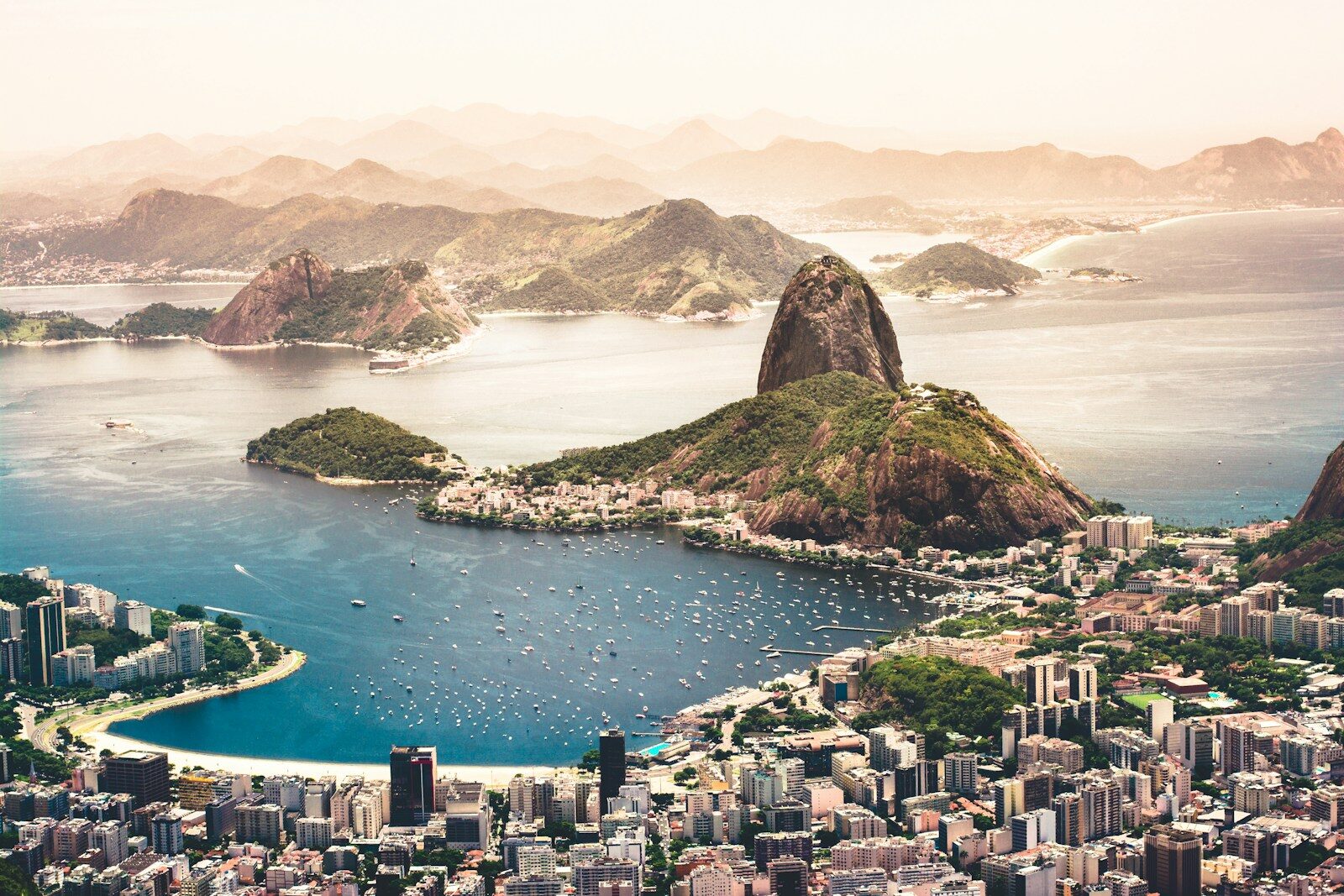
Rio de Janeiro has one of the most dramatic natural settings of any city on earth. Mountains clad in Atlantic forest rise directly from the ocean, interrupted by the curve of famous beaches, the reflective surface of Guanabara Bay, and the sprawling urban tapestry of one of South America’s great metropolises. It is a city that demands to be seen from above as much as at street level.
The two most iconic elevated viewpoints are Sugarloaf Mountain — a 1,299-foot (396-metre) granite monolith rising from the harbour mouth, accessible by cable car in two stages — and the summit of Corcovado Mountain, where the outstretched arms of Christ the Redeemer have overlooked the city since 1931. Both offer extraordinary panoramas that shift dramatically with the light, and sunrise visits to either location can feel genuinely life-affirming.
At sea level, Rio’s beaches are equally legendary. Copacabana’s long, crescent-shaped seafront promenade is one of the world’s great urban beaches — frenetic, democratic, and endlessly watchable. Ipanema and Leblon, its more refined neighbours to the southwest, combine excellent swimming with a sophisticated beachside café culture that makes them ideal for spending an afternoon doing nothing in particular. For a quieter perspective, the viewpoint at Arpoador Rock at sunset captures Ipanema’s entire curved shoreline in warm, golden light — one of Rio’s most reliably romantic moments.
Discover Rio de Janeiro’s Top Tours and Experiences
3. Pelourinho, Salvador — Afro-Brazilian Heritage in Living Colour
Salvador’s Pelourinho neighbourhood is one of the most visually striking urban districts in South America — a densely packed hillside of 17th and 18th-century colonial architecture painted in vivid shades of yellow, blue, pink, and terracotta that cascade down to the lower city below. Recognised as a UNESCO World Heritage Site, the Pelourinho is the historic heart of Salvador and the cultural centre of Afro-Brazilian identity in Brazil.
The neighbourhood’s cobblestone streets wind past churches with gilded baroque interiors, small museums, music schools, and galleries that collectively tell the story of Salvador’s complex and deeply layered past. The Baroque Church of São Francisco is particularly remarkable — its interior is covered in an estimated 880 pounds of gold leaf applied over intricately carved woodwork, making it one of the most opulent religious spaces in the Americas.
Beyond the architecture, Pelourinho is alive with sound and movement. Drumming groups rehearse in the streets, capoeira practitioners spar in the squares, and the smell of acarajé (black-eyed pea fritters fried in dendê palm oil) drifts from street stalls throughout the day. The Largo do Pelourinho square, with its cascading rows of coloured buildings as a backdrop, is the neighbourhood’s visual centrepiece and one of the most photographed spots in all of Brazil.
Explore Salvador’s Historic Centre on a Walking Tour
4. Lençóis Maranhenses National Park — A Landscape Like No Other
Lençóis Maranhenses National Park defies easy categorisation. At first glance it looks like a desert — an enormous expanse of pristine white sand dunes stretching for nearly 600 square miles across Brazil’s northeastern coast. But between the months of February and September, seasonal rains collect in the valleys between the dunes, forming thousands of crystal-clear freshwater lagoons of brilliant turquoise and deep blue that contrast with the white sand in a way that feels almost digitally enhanced.
The result is one of the most surreal and visually arresting landscapes on the planet — a place where you can swim in clear, cool freshwater while surrounded entirely by desert-like dunes, with no trees, no buildings, and nothing on the horizon but sand and sky. The most famous lagoons — Lagoa Azul (Blue Lagoon) and Lagoa Bonita (Beautiful Lagoon) — are typically reached on full-day excursions from the gateway town of Barreirinhas, either by 4×4 vehicle, boat along the Preguiças River, or on foot across the dunes.
The best time to visit is between July and September, when the lagoons are at their fullest and the water is at its clearest. The park receives far fewer international visitors than Brazil’s more famous destinations, which adds to the sense of discovery that makes Lençóis Maranhenses so special.
Book Full-Day Trips to the Lagoons of Lençóis Maranhenses
5. Paraty — A Colonial Jewel on the Costa Verde
Tucked between the mountains and the sea on the Costa Verde (Green Coast) between Rio de Janeiro and São Paulo, Paraty is one of Brazil’s best-preserved colonial towns — and one of its most quietly enchanting. The historic centre, designated a UNESCO World Heritage Site, is closed to motor vehicles, which means its network of uneven cobblestone streets can only be explored on foot. This simple fact transforms the experience entirely: without traffic noise or exhaust, Paraty feels genuinely suspended in the 18th century.
The whitewashed buildings with their brightly painted doors and window frames line streets that were deliberately designed to flood partially at high tide, allowing the sea to act as a natural cleaning system. The sight of the town’s reflections shimmering in the shallow water during full moon high tides is one of the most unique and memorable experiences in Brazil. Behind the town, the Serra da Bocaina mountains rise steeply, their slopes covered in dense Atlantic rainforest that descends almost to the waterfront.
Offshore, the bay is dotted with dozens of tropical islands — most uninhabited, many accessible by the schooner tours that depart from Paraty’s small harbour each morning. The surrounding region also has a growing reputation for cachaça production, with several local distilleries offering tastings of the sugarcane spirit that forms the backbone of Brazil’s national cocktail, the caipirinha.
Explore Paraty and the Costa Verde
6. Ilha Grande — Car-Free Island Paradise
Two hours south of Rio de Janeiro by ferry, Ilha Grande occupies a peculiar place in Brazilian history. Once a pirate haven, then a quarantine station, then a high-security prison for political dissidents — its isolation from the mainland preserved its ecosystem through the centuries when development might otherwise have consumed it. Today, that same isolation is its greatest asset: a car-free island where jungle-covered mountains plunge to crescent beaches of powder-white sand and water so clear it appears almost luminous.
The island’s network of hiking trails links beaches, viewpoints, and waterfalls across a terrain that is largely untouched Atlantic rainforest. The trail to Lopes Mendes Beach — widely regarded as one of the most beautiful beaches in Brazil — passes through dense jungle before emerging onto 1.2 miles (2 kilometres) of fine white sand so soft it squeaks underfoot. The surrounding sea is a shade of emerald green that seems almost theatrical in its perfection.
For those interested in the island’s more unusual history, the ruins of the Dois Rios prison — partially reclaimed by jungle since its closure in 1994 — can be reached on a longer hike and offer a hauntingly atmospheric contrast to the surrounding natural beauty. Boat tours from the main village of Vila do Abraão explore the coastline’s many hidden coves and offer snorkelling in the clear coastal waters.
Discover Ilha Grande by Boat and on Foot
7. The Amazon Rainforest — Earth’s Greatest Wilderness
The Amazon Rainforest is, by almost any measure, the most extraordinary ecosystem on earth. Covering over 2.1 million square miles (5.5 million square kilometres) — approximately 60 percent of which lies within Brazil — it contains an estimated 10 percent of all species on the planet, including more than 40,000 plant species, 1,300 bird species, and 3,000 types of fish. The Amazon River that runs through it carries more water to the sea than any other river in the world.
For visitors, the gateway is typically the city of Manaus in the heart of the Brazilian Amazon — a surprisingly large and sophisticated city of over two million people, famous for its ornate 19th-century opera house and its position at the confluence of the Rio Negro and the Amazon River. Here, the Meeting of Waters creates one of the most visually striking natural phenomena in South America: the dark, tannin-rich waters of the Rio Negro and the sandy-brown Amazon River flow side by side for several miles without mixing, their different temperatures and flow speeds keeping them visually distinct.
Multi-day jungle lodges along the river’s tributaries offer the most immersive experience of the rainforest — waking before dawn for wildlife walks, spending days on the water watching pink river dolphins, piranhas, and caimans, and sleeping to the sound of the forest at night. Even a two-day excursion from Manaus provides a genuine sense of the Amazon’s scale and complexity.
Book Amazon Jungle Tours and River Lodge Experiences
8. Florianópolis — Brazil’s Island of 42 Beaches
Florianópolis — universally known as “Floripa” among Brazilians — is a city built on an island off Brazil’s southern coast, connected to the mainland by a pair of bridges and blessed with a diversity of natural environments that is remarkable even by Brazilian standards. Its 42 beaches range from calm, sheltered lagoon shores ideal for families to exposed Atlantic breaks that draw surf enthusiasts from across the southern hemisphere.
The Lagoa da Conceição, a large coastal lagoon in the island’s interior, sits at the heart of Floripa’s most sought-after neighbourhood — surrounded by dunes, forested hills, and a string of restaurants, bars, and boutiques that give it a sophisticated, laid-back atmosphere unlike anywhere else in southern Brazil. Joaquina Beach, at the mouth of the lagoon, is one of the country’s most celebrated surf destinations, with reliable year-round breaks and a lively beachside culture that stays busy well into the evening.
The viewpoint atop Morro da Cruz — the island’s highest accessible hill — provides a panorama that captures the full geographical improbability of Florianópolis: a city and its interconnected chain of lagoons, beaches, and forested mountains, all contained within a single island connected to the continent by two slender bridges. The stone formations at Praia Mole, best seen at sunrise when the granite turns golden in the early light, are among the most photogenic rock formations on Brazil’s southern coast.
Book Beach Tours and Boat Trips in Florianópolis
9. Jericoacoara — Dunes, Wind, and Perfect Sunsets
Jericoacoara — or simply “Jeri” to those who know it — occupies a special place in Brazil’s travel landscape: remote enough to feel like a genuine escape, refined enough to attract visitors who want more than just a beach. Located on Brazil’s northeastern coast in the state of Ceará, its streets are made of sand rather than asphalt, motor vehicles are restricted to designated areas, and the horizon from the famous Duna do Pôr do Sol (Sunset Dune) is entirely unobstructed — just the Atlantic Ocean and, on clear evenings, a sunset that draws crowds every single day.
Jeri first built its reputation as a windsurfing destination — the consistent trade winds that blow from June through February create near-perfect conditions for both windsurfing and kitesurfing, attracting serious water sports enthusiasts from Europe and North America. But the town has evolved considerably since those early days, developing a sophisticated hospitality scene of boutique pousadas, open-air restaurants, and a bohemian social life that makes it one of Brazil’s most enjoyable places simply to slow down and exist.
The surrounding landscape offers several remarkable natural features. Pedra Furada, a natural stone arch carved by the sea, frames the setting sun in what has become one of the most iconic photographs in Brazilian travel. Lagoa Paraíso, a large freshwater lagoon a short buggy ride from town, is known for its crystal-clear water and the floating hammock-equipped platforms at its edges — a setting that effortlessly combines natural beauty with the kind of languid relaxation that Jericoacoara does better than almost anywhere else in Brazil.
Go Dune Buggying and Beach Exploring in Jericoacoara
Final Thoughts: Planning Your Brazil Adventure
Brazil’s size means that no single trip can cover everything — the country is larger than the continental United States, and the distances between its most spectacular destinations are considerable. The key is to choose your regions strategically rather than trying to see too much at once. A first visit to Brazil might combine Rio de Janeiro and the Costa Verde (including Paraty and Ilha Grande) with a flight north to Foz do Iguaçu for the falls. A second visit might venture into the Amazon or the northeast for Lençóis Maranhenses and Jericoacoara.
However you structure your itinerary, Brazil consistently rewards those who invest the time to explore beyond the obvious highlights. The country’s natural and cultural diversity is genuinely without parallel in South America — and every one of these nine destinations offers an experience that is entirely, unmistakably its own.
Plan and Book Your Brazil Journey
FAQs: Beautiful Places in Brazil
What is the most famous part of Brazil?
Rio de Janeiro is arguably Brazil’s most internationally recognised destination, with its iconic combination of mountains, beaches, and landmarks like Christ the Redeemer and Sugarloaf Mountain. However, for sheer natural spectacle, Iguazu Falls — a UNESCO World Heritage Site and one of the New Seven Wonders of Nature — makes an equally strong claim. The Amazon Rainforest, covering over 60 percent of Brazil’s territory, is the country’s most significant natural asset on a global scale.
What are the Seven Wonders found in Brazil?
Brazil is home to one of the New Seven Wonders of Nature: the Amazon Rainforest, recognised in 2011 as one of the world’s most extraordinary natural environments. Iguazu Falls, while straddling the border between Brazil and Argentina, is also frequently cited among the world’s great natural wonders and holds UNESCO World Heritage status. Brazil additionally claims one of the New Seven Wonders of the World in the form of Christ the Redeemer, the iconic Art Deco statue overlooking Rio de Janeiro from the summit of Corcovado Mountain.
What are some picturesque beaches to visit in Brazil?
Brazil’s coastline contains an extraordinary range of beach experiences. Lopes Mendes on Ilha Grande is widely regarded as one of the most beautiful beaches in the country — pristine, car-free, and backed by Atlantic rainforest. Jericoacoara’s beaches on the northeastern coast combine dramatic dune scenery with world-class conditions for wind and kite surfing. Copacabana and Ipanema in Rio de Janeiro are among the most famous urban beaches in the world. And the remote island of Fernando de Noronha, a marine protected area off the northeastern coast, is home to some of Brazil’s most unspoiled and ecologically rich beaches.
What are some scenic viewpoints in Brazil?
Brazil offers an impressive collection of elevated perspectives. The cable car to the top of Sugarloaf Mountain in Rio delivers one of the great urban panoramas in South America. The summit platform at Christ the Redeemer on Corcovado provides a 360-degree view of Rio that encompasses the city, its mountains, and the sea simultaneously. The Morro da Cruz viewpoint in Florianópolis captures the island city’s unique geography in a single frame. And for natural scenery, the elevated walkways on the Brazilian side of Iguazu Falls offer sweeping views of the falls that are difficult to match anywhere on earth.
What is the most visited attraction in Rio de Janeiro?
Christ the Redeemer consistently ranks as Rio de Janeiro’s most visited attraction, drawing millions of visitors each year to the summit of Corcovado Mountain. The statue stands 98 feet (30 metres) tall on a 26-foot (8-metre) pedestal and has overlooked the city since its completion in 1931. It was named one of the New Seven Wonders of the World in 2007. Sugarloaf Mountain is a close second in terms of visitor numbers, offering a different but equally spectacular perspective on the city and its harbour.