
Ask most people what they know about Carnival in Brazil and the answer will almost always centre on Rio de Janeiro — the Sambadrome, the feathered costumes, the samba schools. And Rio’s Carnival is, without question, one of the great spectacles of the modern world. But reducing Brazilian Carnival to a single city is like reducing Brazil itself to a single city: it misses the point entirely.
Carnival in Brazil is a genuinely national celebration, and each region has shaped it in its own image. In São Paulo, it’s urban, diverse, and community-driven, with blocos that reflect the city’s extraordinary cultural mix. In Salvador, it’s a moving, multi-day music circuit powered by axé rhythms and deep-rooted Afro-Bahian tradition. In Recife and Olinda, it’s a living expression of Pernambuco’s unique musical heritage — frevo orchestras, maracatu drumming, and giant puppets weaving through colonial streets. In São Luís, it draws on Indigenous and African storytelling traditions that most international visitors have never encountered. And in Florianópolis, it takes on the easy, outdoorsy character of an island city that does everything at its own pace.
This guide covers the Carnival celebrations that best illustrate how broad, how musically rich, and how culturally distinct this festival really is across Brazil.
Carnival in Brazil at a Glance
- Best for folklore traditions: Recife — home of frevo and maracatu, two of Brazil’s most historically significant Carnival rhythms
- Best for street parties: São Paulo — a fast-growing bloco scene with themed, community-led processions across the city
- Best for parade spectacle: Rio de Janeiro — the Sambadrome samba school parades are unmatched in scale and production
- Best for music lovers: Salvador — axé, pagode, and Afro-Bahian rhythms dominate a continuous, city-wide open-air circuit
Experience Rio de Janeiro’s Samba School Parades
1. Rio de Janeiro — The World’s Most Famous Carnival
Rio’s Carnival is a production on a scale that is difficult to fully comprehend until you’re inside it. The samba school parades at the Sambadrome — the purpose-built parade venue designed by Oscar Niemeyer and stretching over half a kilometre along the Marquês de Sapucaí — are the centrepiece of the entire event. Each of the twelve competing samba schools presents a full theatrical production: a chosen theme explored through original music, elaborate costumes, choreography, and towering floats, all delivered by thousands of participants who have been rehearsing since the previous year. The parades typically run across two nights, with the top schools competing on Sunday and Monday and a champions’ parade held the following Saturday.
The themes chosen by Rio’s samba schools are never trivial. Schools regularly use Carnival as a platform to explore Afro-Brazilian cultural heritage, political commentary, and social history — producing performances of genuine artistic ambition that go far beyond spectacle. Following the work of a particular school throughout the year and then watching their parade in full is one of the most immersive cultural experiences available anywhere in Brazil.
Outside the Sambadrome, Rio transforms into one continuous street party. Hundreds of blocos operate across the city’s neighbourhoods from the week before the official Carnival weekend through to the following Tuesday. From the early-morning brass bands that wind through the hillside streets of Santa Teresa to the enormous Cordão da Bola Preta march in the city centre — which regularly draws over a million participants — there is no single experience of Rio’s Carnival. It is everywhere, all at once, for days at a time.
Join Rio’s Carnival Scene with Samba Tours and Backstage Access
2. São Paulo — Brazil’s Fastest-Growing Carnival Scene
São Paulo’s Carnival has undergone a remarkable transformation over the past decade, evolving from a celebration that played a secondary role to Rio’s into one of Brazil’s largest and most culturally significant festivals. The city’s Anhembi Sambadrome hosts samba school parades that rival Rio’s in ambition if not yet in scale — typically beginning late at night and stretching well toward dawn, with schools drawing on the cultural identities of São Paulo’s extraordinarily diverse communities.
The schools that compete in São Paulo reflect the city’s character: strong influences from northeastern Brazilian migrants, Black cultural organisations, and LGBTQ+ groups have shaped a Carnival aesthetic that is distinctly urban, contemporary, and politically engaged. Themes that address race, identity, and social justice appear regularly in the parade productions, giving São Paulo’s Carnival a distinctive edge that sets it apart from other major cities.
On the streets, the bloco scene has expanded rapidly year on year. The area around Avenida Paulista and República sees some of the largest gatherings, with percussion groups, DJs, drag performers, and community bands filling the avenues with a mix of sounds and styles that reflects the city’s metropolitan energy. São Paulo’s Carnival is less cohesive than Rio’s or Salvador’s — it sprawls across the city in dozens of simultaneous events — but that sense of decentralised, democratic celebration is precisely what makes it feel authentically Paulistano.
Explore São Paulo’s Nightlife and Cultural Scene
3. Salvador — The World’s Largest Open-Air Music Event
Salvador’s Carnival operates on a completely different logic from Rio’s or São Paulo’s. There is no fixed parade route, no Sambadrome, no single focal point. Instead, the celebration unfolds across several official circuits simultaneously — long coastal and urban avenues along which trios elétricos (enormous truck-mounted stages equipped with powerful sound systems) move slowly through immense crowds of foliões (revellers), playing live music for hours at a stretch.
The soundtrack is axé — the Bahian pop genre built on African rhythmic foundations — alongside pagode, samba-reggae, and the powerful percussion of Afro-Bahian cultural groups. Ilê Aiyê, one of the oldest and most celebrated Afro-Brazilian groups in the country, has paraded at Salvador’s Carnival since 1975 and remains one of the event’s most emotionally charged experiences. Filhos de Gandhy, a male-only afoxé group founded in 1949 by dockers inspired by the figure of Gandhi, leads one of the most distinctive processions — thousands of men dressed in white and blue robes moving in deliberate, meditative formation through the streets.
Salvador organises its Carnival across several distinct circuits, each with its own atmosphere. The Barra-Ondina circuit runs along the seafront, combining ocean views with some of the biggest musical acts. The Campo Grande circuit passes through the historic city centre and tends to attract a broader local crowd. The Pelourinho circuit — set within the UNESCO-listed colonial district itself — hosts more traditional percussion groups and cultural organisations in its squares and narrow streets, offering the most intimate and historically resonant experience of the three.
Discover Afro-Bahian Culture and Music in Salvador
4. Recife — The Capital of Frevo and Maracatu
Recife’s Carnival is anchored in musical traditions that are unique to the state of Pernambuco and unlike anything found elsewhere in Brazil. Frevo — a fast, intensely rhythmic style of brass-driven music that developed in the early 20th century from military marching bands and capoeira — is the dominant sound of the celebration, accompanied by frevo dancers performing the extraordinary acrobatic steps of the genre, spinning colourful parasols as they move. The combination of speed, precision, and joy in a good frevo performance is genuinely astonishing to witness for the first time.
Maracatu, an Afro-Indigenous ceremonial rhythm rooted in Pernambuco’s colonial-era African kingdoms and their spiritual traditions, adds a different dimension to Recife’s Carnival — deeper, more percussive, and more ritualistic than the frevo bands. Maracatu nations (as the groups are called) parade in elaborate costumes with a strict hierarchical structure that reflects the tradition’s historical origins.
The most celebrated single event of Recife’s Carnival is the Galo da Madrugada — literally the “Rooster of the Early Morning” — a massive Saturday procession that begins at dawn and draws millions of participants into the city’s streets. The scale of the Galo da Madrugada has earned it a place in the Guinness World Records as the world’s largest street Carnival block, a distinction that Recifenses wear with considerable pride. Beyond the major events, different neighbourhoods host their own stages, orchestras, and dance groups throughout the week, creating a network of celebrations that rewards those who wander beyond the main circuits.
Explore Recife’s Historic Culture and Carnival Traditions
5. Olinda — Giant Puppets and Colonial Streets
Just a few miles north of Recife along the coast, Olinda offers a Carnival experience that contrasts sharply with its larger neighbour despite sharing many of the same musical roots. Built on a series of steep hills that descend to the sea, this beautifully preserved colonial town — its historic centre also a UNESCO World Heritage Site — provides one of the most atmospheric settings for Carnival anywhere in Brazil. The narrow, winding streets create a labyrinthine route for processions, and the combination of 17th-century architecture, tropical gardens, and the sound of frevo orchestras echoing between buildings is genuinely unlike anything else.
Olinda’s most iconic Carnival tradition is its bonecos gigantes — enormous papier-mâché puppets, sometimes reaching several metres in height, that are carried through the crowds on the shoulders of their operators. These figures often represent public figures, politicians, artists, or beloved local characters, and their exaggerated, comic features give them an irreverent quality that perfectly captures the spirit of Carnival satire. Seeing a three-metre puppet of a famous Brazilian politician weaving through the packed streets of a 17th-century colonial town to the sound of a frevo orchestra is one of those moments that stays with you.
Unlike Salvador’s organised circuits or Rio’s ticketed parade events, Olinda’s Carnival has no official structure. Processions form spontaneously throughout the day and evening, and the city essentially becomes one continuous, unscripted celebration for the duration of the festival. Simply walking through the streets during Carnival is enough to put you at the centre of something extraordinary.
Discover Olinda and Recife on a Guided City Tour
6. São Luís — Roots, Rhythms, and Indigenous Heritage
São Luís, the capital of Maranhão in Brazil’s northeastern corner, offers a Carnival experience that is markedly different in scale and character from the mega-events of Rio, Salvador, or Recife — but no less interesting for it. This is a Carnival shaped by Maranhão’s distinctive cultural heritage, which blends African, Indigenous, and Portuguese influences in combinations found nowhere else in Brazil.
The rhythms that dominate São Luís’s Carnival are largely unfamiliar to visitors from other parts of the country: tambor de crioula, a drum-based tradition with deep African roots, and bloco tradicional processions that combine local dance styles with community storytelling. Many of these celebrations incorporate early elements of bumba meu boi — Maranhão’s most important cultural festival, traditionally held in June but whose preparations and influences permeate the city’s Carnival.
The setting reinforces the sense of encountering something genuinely rooted and local. Processions move through the UNESCO-listed historic centre, where streets of Portuguese-tiled facades and crumbling colonial mansions provide a backdrop that feels both grand and intimate. São Luís’s Carnival doesn’t try to compete with Brazil’s more internationally famous celebrations — it has its own identity, its own rhythms, and its own reasons for existing, all of which make it one of the more rewarding and least-visited Carnival destinations in the country.
7. Florianópolis — Coastal Carnival with Island Character
Florianópolis’s Carnival reflects the personality of the city itself: relaxed, outdoorsy, and shaped by its island setting. While it lacks the international profile of Rio’s Sambadrome or the sheer scale of Salvador’s circuits, it offers a Carnival experience that is genuinely enjoyable and distinctly its own — a combination of street parties in the historic centre, neighbourhood blocos that spill toward the beaches, and a social atmosphere that prioritises fun over formality.
The city’s best-known Carnival tradition is the Bloco dos Sujos — a long-running procession whose name translates loosely as the “Dirty Block,” a reference to older local customs in which men dressed in deliberately outrageous, exaggerated costumes to signal the opening of the festival season. The tradition has evolved considerably but retains its irreverent, community spirit.
In the evenings, samba groups and percussion bands congregate around Praça XV in the city centre, while smaller blocos move through neighbourhoods like Lagoa da Conceição and Ribeirão da Ilha. The atmosphere is lighter and more accessible than Brazil’s major Carnival cities — easier to navigate, less overwhelming, and a good option for first-time Carnival visitors who want to experience the celebration without being thrown into its deepest end.
Book Florianópolis Experiences and Beach Excursions
Final Thoughts: Choosing Your Brazilian Carnival
The best city for Carnival in Brazil depends entirely on what you’re looking for. If the samba school parade spectacle is the draw, Rio is irreplaceable. If music is your priority, Salvador’s continuous, city-wide circuit is unmatched in energy and duration. If cultural history and musical tradition matter most, Recife and Olinda offer an experience rooted in centuries of Pernambuco identity that you won’t find anywhere else. And if you want something more intimate and less overwhelming for a first Carnival, São Paulo’s bloco scene or Florianópolis’s coastal celebrations offer an accessible introduction to a festival that Brazil has, across its different regions, made entirely its own.
Whatever you choose, book accommodation early — ideally months in advance for the most popular destinations — and come with comfortable shoes, light clothing, and a willingness to follow the music wherever it leads.
Find and Book Carnival Tours and Experiences Across Brazil
FAQs: Brazil’s Best Carnival Celebrations
Which city in Brazil is most famous for its Carnival celebration?
Rio de Janeiro is the most internationally recognised Carnival destination in Brazil and the world, famous for its Sambadrome samba school parades and its city-wide bloco street parties. However, Salvador in Bahia makes a strong claim as the most musically immersive Carnival destination — its open-air circuit draws enormous crowds over several days and is considered by many Brazilians to be the most authentic and energetically charged celebration in the country. Recife and Olinda are equally beloved for their unique musical traditions.
What is the main event of Carnival in Brazil?
The answer varies by city. In Rio de Janeiro, the main event is the samba school parade competition at the Sambadrome, where twelve elite schools compete across two nights in an extraordinary display of music, costume, and choreography. In Salvador, the centrepiece is the axé and pagode circuit along Barra-Ondina and other official routes, led by trios elétricos carrying famous artists through crowds of hundreds of thousands. In Recife, the Galo da Madrugada Saturday procession — reportedly the world’s largest street Carnival block — is the defining event of the week.
How long do Carnival celebrations in Brazil last?
Officially, Brazilian Carnival spans five days — from the Friday before Ash Wednesday through to the Tuesday (Fat Tuesday), with Ash Wednesday marking the beginning of Lent and the formal end of the festivities. In practice, many cities extend the celebrations considerably. Rio’s bloco scene begins weeks before the official Carnival weekend, while Salvador’s circuits run for a full six days. Some cities hold a Micareta — an out-of-season Carnival — in the months following the main event, most notably in Bahia.
What are some traditional costumes worn during Carnival in Brazil?
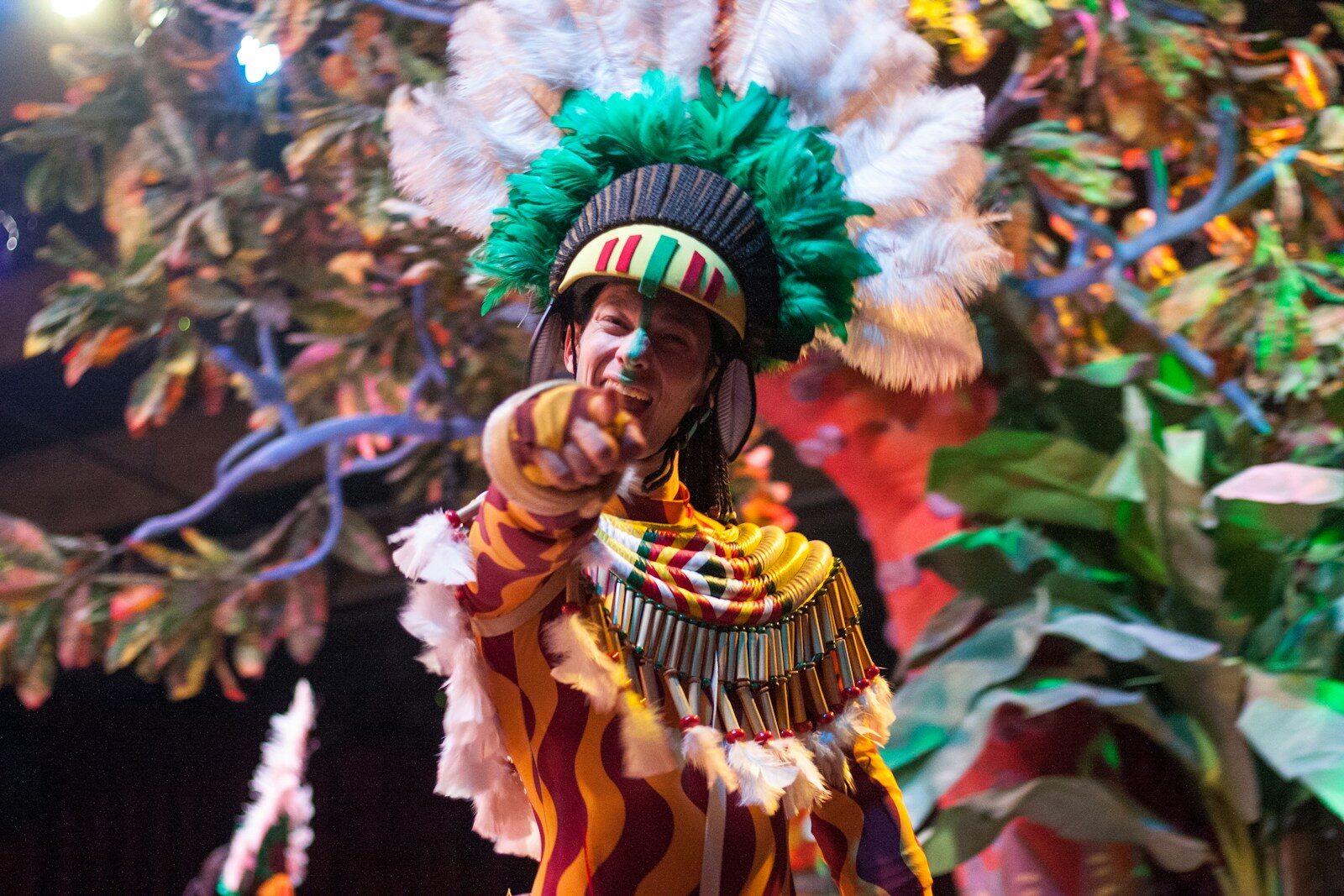
Costume traditions vary significantly between cities and contexts. Rio’s Sambadrome features the most elaborate costumes in the world — samba schools invest enormous resources in custom-designed outfits built around their parade theme, incorporating feathers, sequins, metalwork, and hand-painted fabrics. Street bloco costumes are far more informal and often themed around the individual bloco’s identity. In Olinda, the bonecos gigantes puppet carriers wear costumes that reflect the character they’re portraying. Salvador’s Carnival costumes are often colour-coded by cultural group — Filhos de Gandhy’s white and blue robes being one of the most recognisable examples.
Can visitors participate in Carnival parades in Brazil?
Yes — several options exist for visitors who want to participate rather than simply watch. Some Rio samba schools offer positions for paying visitors within their parade formations, providing costumes and a place in the procession in exchange for a fee that contributes to the school’s production budget. Street blocos in Rio, São Paulo, and elsewhere are entirely open to anyone who shows up — no ticket, no registration, no costume required, though many participants dress up for the occasion. In Salvador, abadás (official bloco t-shirts or wristbands) are sold for many of the organised circuits and grant access to specific spaces along the route.