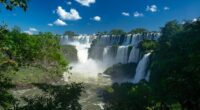
Argentina’s reputation is built largely on its natural wonders — the thundering cataracts of Iguazu, the jagged granite spires of Patagonia, the sweeping vineyards of Mendoza. But scratch the surface and you’ll find a country equally rich in history, with a cultural heritage that stretches from pre-Incan civilizations to colonial-era Jesuit missions to the turbulent political dramas of the 20th century.
Whether you’re standing in the vast, politically charged expanse of the Plaza de Mayo in Buenos Aires, running your fingers along ancient handprints at Cueva de las Manos in Santa Cruz, or tracing the worn stone paths of an Inca road through the Andean highlands, Argentina’s historical sites have a depth and variety that consistently surprises first-time visitors. These are ten of the most significant and rewarding historical places in Argentina — each one offering a distinct window into the country’s layered and fascinating past.
Explore Argentina’s History with a Guided Tour
1. San Ignacio Mission, Misiones
Hidden within Argentina’s lush subtropical rainforest in the northeastern province of Misiones, the ruins of San Ignacio Mission rank among the country’s most evocative historical sites. Founded by Jesuit missionaries in the 17th century, this UNESCO World Heritage Site once served as a self-contained community for the indigenous Guaraní people, blending European religious ambitions with local culture and craftsmanship in ways that were remarkable for their time.
Walking through the ruins today, you can still read the story of this experiment in stone. The surviving walls and archways reveal a confident fusion of Spanish Baroque architecture and Guaraní artistic traditions — most visibly in the elaborate stone carvings that decorate what remains of the church and residential quarters. The overgrown red sandstone structures, reclaimed at the edges by the surrounding jungle, lend the site an atmosphere that photographs struggle to fully capture. For anyone interested in colonial history or the complex legacy of the Jesuit presence in South America, San Ignacio is an essential stop.
Address: Rivadavia y Gendarme Medina, N3322 San Ignacio, Misiones
Opening Hours: Daily, 9:00 AM – 7:00 PM
Explore the Jesuit Ruins of San Ignacio
2. Plaza de Mayo, Buenos Aires
No single location in Argentina carries more historical or political weight than the Plaza de Mayo in the heart of Buenos Aires. The square takes its name from the May Revolution of 1810, the pivotal moment when Argentina began its path toward independence from Spanish colonial rule. In the two centuries since, it has remained the focal point of Argentine public life — the stage for celebrations, protests, military coups, and moments of national reckoning that have shaped the country’s identity.
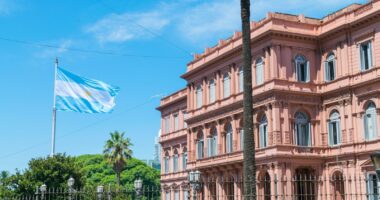
At its centre stands the Pirámide de Mayo, the country’s oldest national monument. Surrounding the plaza are several of Buenos Aires’ most historically significant buildings: the imposing pink facade of the Casa Rosada (the presidential palace), the Metropolitan Cathedral, and the Cabildo — the colonial town hall that served as the seat of government during the independence era. Spending time here, even just wandering the square and taking in its layers of history, provides an invaluable orientation to Argentine history and the forces that have shaped the country.
Address: Av. Hipólito Yrigoyen s/n, C1087 Buenos Aires
Opening Hours: Open 24 hours
Discover Buenos Aires’ Historic Landmarks on a City Tour
3. Recoleta Cemetery, Buenos Aires
Recoleta Cemetery is unlike any burial ground you’re likely to have visited before. Spanning 14 acres in one of Buenos Aires’ most elegant neighbourhoods, it functions less as a conventional cemetery and more as an open-air museum of neoclassical architecture, sculpture, and Argentine political history. The avenues between its mausoleums feel like streets in a miniature city, lined with elaborate marble tombs commissioned by the country’s most powerful families over nearly two centuries.
The cemetery holds the remains of Argentine presidents, Nobel Prize winners, military heroes, and aristocrats — a who’s who of the country’s ruling class across the generations. Its most visited tomb belongs to Eva Perón, the beloved and divisive First Lady whose influence on Argentine politics and culture remains deeply felt to this day. Even visitors with no particular interest in history find Recoleta Cemetery compelling — the quality of the sculpture and architecture alone justifies the visit.
Address: Junín 1760, C1113 Buenos Aires
Opening Hours: Monday – Friday, 9:00 AM – 5:00 PM
4. Cueva de las Manos, Santa Cruz
In a remote canyon in the Santa Cruz province of Patagonia, the Cave of the Hands offers one of the most extraordinary encounters with ancient human history anywhere in the Americas. The site takes its name from the hundreds of stencilled handprints that cover its walls — created between 13,000 and 9,500 years ago by hunter-gatherer groups who inhabited the region long before the arrival of the Incas, the Spanish, or any of the civilisations that followed.
The cave paintings at Cueva de las Manos go well beyond the handprints. Vivid hunting scenes depict guanacos (wild llamas) being pursued across the rock face, rendered in ochre, white, black, and red pigments derived from natural minerals. The level of preservation is remarkable given their age, and the sheer quantity of overlapping images — accumulated across thousands of years — gives the site a cumulative power that’s genuinely hard to describe. Recognised as a UNESCO World Heritage Site, Cueva de las Manos stands as one of Argentina’s most significant archaeological treasures.
Address: Santa Cruz Province, Argentina
Opening Hours: Monday – Friday, 9:00 AM – 6:00 PM
Book Cave and Archaeology Tours in Patagonia
5. Teatro Colón, Buenos Aires
Widely regarded as one of the finest opera houses in the world, the Teatro Colón is a landmark that transcends Argentina’s borders. Originally opened in 1857 and rebuilt in its current form in 1908, the theatre is an architectural triumph that draws on Italian Renaissance and French Baroque influences — its grand exterior colonnades, sweeping staircases, and intricately detailed interiors placing it comfortably among the great performance venues of Europe and the Americas.
What genuinely sets Teatro Colón apart, however, is not just the beauty of its design but the quality of its acoustics. The theatre’s acoustic properties are considered exceptional by international standards, making it a preferred venue for the world’s leading opera singers, orchestras, and ballet companies. Guided tours of the interior run regularly and offer access to the main auditorium, backstage areas, and the theatre’s workshops — where costumes, sets, and props are still produced on-site by a team of resident artisans.
Address: Cerrito 628, C1010 Buenos Aires
Opening Hours: Monday – Saturday, 9:00 AM – 8:00 PM | Sunday, 9:00 AM – 5:00 PM
Visit Teatro Colón on a Skip-the-Line Guided Tour
6. Cathedral of Córdoba, Córdoba
Argentina’s oldest continuously operating church, the Cathedral of Córdoba has stood at the heart of the city since the 1500s, undergoing successive waves of renovation and architectural expansion across the following centuries. The result is a building that layers several distinct periods of Argentine religious and colonial history into a single, cohesive structure — its Baroque facade giving way to a richly decorated interior that rewards careful attention.
Inside, the central nave is lined with ornate wood and gilt mouldings, and a series of religious sculptures occupy the alcoves along the walls. The cathedral’s dome, added during one of its later renovations, floods the interior with natural light and lends the space an unexpected sense of grandeur. As both a working church and a historical monument, the Cathedral of Córdoba remains an active part of the city’s life rather than simply a museum piece — which gives a visit here a different quality from many of Argentina’s other heritage sites.
Address: Independencia 80, X5022 Córdoba
Opening Hours: Monday – Saturday, 10:00 AM – 6:00 PM | Sunday, 8:30 AM – 11:30 AM and 3:30 PM – 6:00 PM
Discover Córdoba’s Historic City Centre
7. Pucará de Tilcara, Jujuy Province
Perched on a hillside above the Quebrada de Humahuaca — a dramatic, UNESCO-listed valley in Argentina’s northwestern Jujuy Province — Pucará de Tilcara is one of the country’s most important pre-Columbian archaeological sites. Built around the 12th century by a culture that predated the Inca expansion into the region, the fortification served as a strategic settlement overlooking the valley below, its terraced stone structures and defensive walls still largely intact after centuries of exposure to the harsh Andean elements.
In the early 20th century, archaeologists from the University of Buenos Aires undertook a major restoration of the site, stabilising the surviving structures and reconstructing key elements of the original layout. Today, visitors can walk through the terraced streets, explore the ceremonial spaces, and take in views across the polychrome valley that provide important context for understanding why this location was chosen. A small onsite museum adds further archaeological and anthropological depth to the experience.
Address: Y4624 Tilcara, Jujuy Province
Opening Hours: Tuesday – Sunday, 9:00 AM – 6:30 PM | Closed Monday
Explore Pre-Incan Sites and the Quebrada de Humahuaca
8. Casa Rosada, Buenos Aires
With its distinctive rose-pink facade overlooking the eastern end of the Plaza de Mayo, the Casa Rosada is one of the most recognisable buildings in South America. As the official workplace of the Argentine president, it occupies the same symbolic role in Argentine political life that the White House holds in the United States — and its history is at least as turbulent. It was from the balcony of the Casa Rosada that Eva Perón delivered her most celebrated speeches, and the building has witnessed virtually every major chapter of Argentina’s complex modern political story.
Visitors can explore the building’s public areas on guided tours, which run on Wednesdays through Sundays and on public holidays. The onsite museum traces Argentina’s presidential history through a collection of portraits, personal artefacts, and historical documents, providing a thoughtful and nuanced account of the country’s political evolution. Even without entering, standing in front of the Casa Rosada and considering the weight of history that has played out on its steps and balconies is a quietly powerful experience.
Address: Balcarce 78, C1064 Buenos Aires
Opening Hours: Wednesday – Sunday and public holidays, 10:00 AM – 6:00 PM
Discover Buenos Aires’ Political and Cultural History
9. Jesuit Block (Manzana Jesuítica), Córdoba
In the historic centre of Córdoba, the Manzana Jesuítica — or Jesuit Block — represents one of the most intact examples of Jesuit colonial architecture in South America. Designated a UNESCO World Heritage Site, this cluster of 17th- and 18th-century buildings once formed the administrative and educational heart of the former Jesuit Province of Paraguay, which encompassed a vast territory stretching across present-day Argentina, Paraguay, and Brazil.
The block includes Argentina’s oldest university (the Universidad Nacional de Córdoba, founded in 1613), the oldest church still in operation in the country, and the former residences of the Jesuit fathers who administered the province. One of the site’s most remarkable features is the Main Library of the Colegio Máximo de Córdoba, which holds a collection of over 1,600 volumes predating 1767 — the year the Jesuits were expelled from Spanish colonial territories. For anyone interested in the intersection of education, religion, and colonial power in South America, the Jesuit Block is a genuinely unmissable destination.
Address: Av. Vélez Sarsfield 215, X5000 Córdoba
Opening Hours: Monday – Friday, 9:30 AM – 5:30 PM | Saturday, 9:30 AM – 2:30 PM | Closed Sunday
Tour the Jesuit Block and Historic Córdoba
10. Qhapaq Ñan — The Andean Road System
One of the most ambitious engineering achievements of the ancient world, the Qhapaq Ñan was the arterial network of roads that held the Inca Empire together. Stretching over 30,000 kilometres across six modern South American nations, this extraordinary system of stone-paved paths, suspension bridges, and mountain passes reached its greatest extent in the 15th century — connecting the empire’s far-flung territories and enabling the movement of armies, messengers, trade goods, and administrative directives across some of the most challenging terrain on earth.
In Argentina, sections of the Qhapaq Ñan can be traced through the Andean northwest, running through the provinces of Jujuy, Salta, Tucumán, Catamarca, La Rioja, and San Juan before reaching as far south as Mendoza. These surviving stretches pass through dramatically varied landscapes — from snow-capped mountain passes to arid desert plains — and in doing so offer a vivid sense of the geographical scale of Inca ambition. Recognised as a UNESCO World Heritage Site shared across its six member countries, the Andean Road System is both a testament to ancient engineering ingenuity and a remarkable living link to a pre-Columbian civilisation of extraordinary sophistication.
Opening Hours: Accessible year-round; conditions vary by section and season
Explore the Andean Highlands and Inca Heritage of Mendoza
Final Thoughts on Argentina’s Historical Sites
From the jungle-shrouded Jesuit ruins of Misiones to the ancient handprints of a Patagonian cave, Argentina’s historical places span an extraordinary range of eras, cultures, and stories. The country’s UNESCO World Heritage Sites alone could anchor a dedicated itinerary, but the real reward lies in moving between the different layers of Argentine history — from pre-Columbian civilisations to colonial settlements to the modern political dramas of Buenos Aires — and seeing how each one has shaped the country you’re travelling through today.
Whether you have a week in Buenos Aires or a month to explore the country from end to end, weaving these historical sites into your itinerary will add a dimension to your trip that no amount of natural scenery alone can provide.
Book Cultural and Historical Tours Across Argentina
FAQs: Historical Places in Argentina
What is the most famous monument in Argentina?
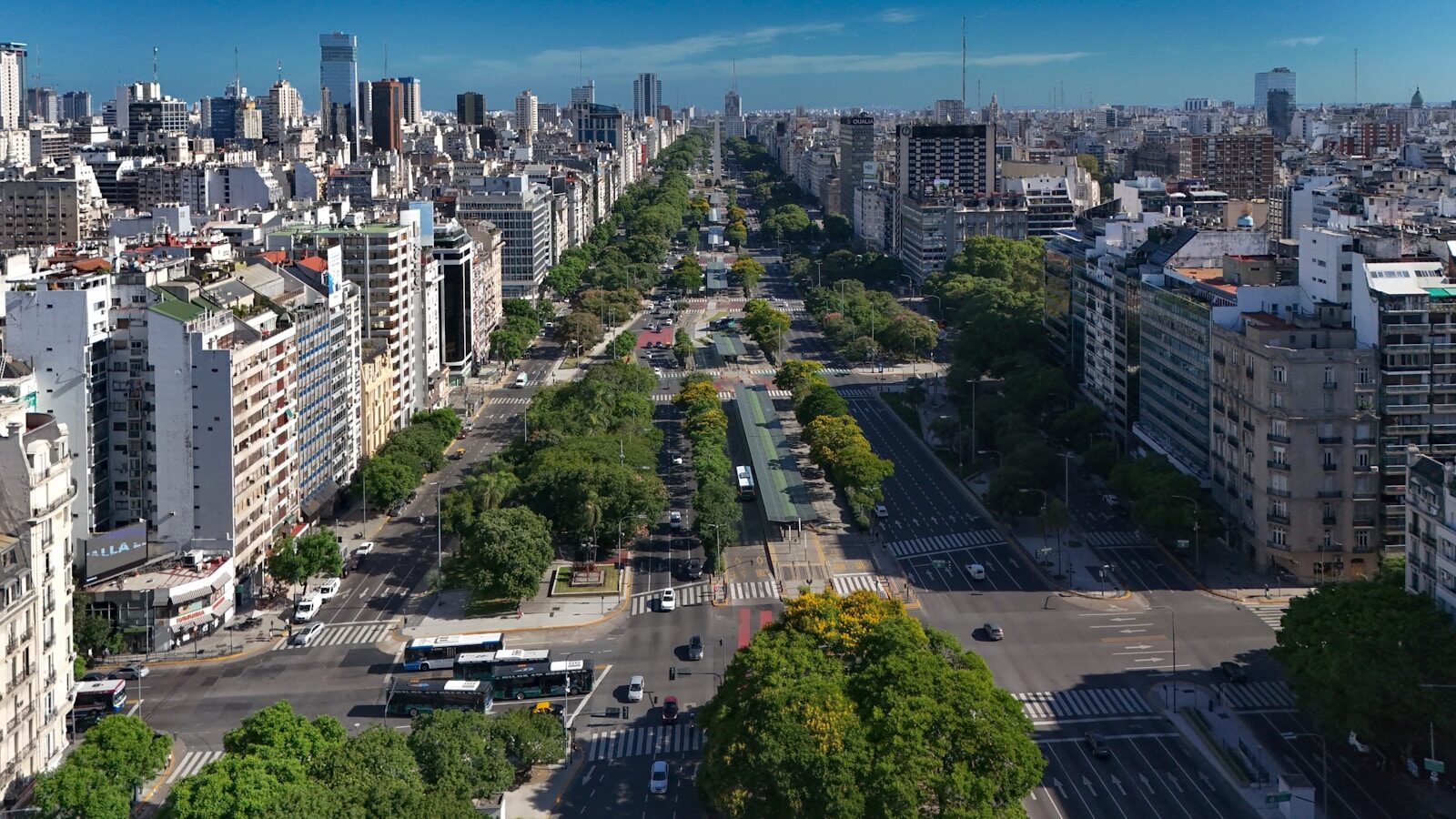
The Obelisco de Buenos Aires is arguably the country’s most iconic monument. Located at the intersection of Corrientes Avenue and the broad 9 de Julio Avenue — widely cited as the widest avenue in the world — the obelisk was built in 1936 to mark the 400th anniversary of Buenos Aires’ original founding. It has since become the defining symbol of the city and a natural gathering point for celebrations, protests, and public events of every kind.
Are there ancient ruins to visit in Argentina?
Yes, and they span an impressive range of periods and cultures. Cueva de las Manos in Santa Cruz Province contains rock art dating back as far as 13,000 years, making it one of the oldest archaeological sites in the Americas. Pucará de Tilcara in Jujuy Province preserves the stone fortifications of a pre-Incan civilisation from the 12th century. And sections of the Qhapaq Ñan — the ancient Inca road network — can be walked in the Andean northwest. Argentina’s pre-Columbian heritage is far richer than many visitors expect.
Are guided tours available at historical sites in Argentina?
Guided tours are available at the vast majority of Argentina’s major historical sites, and in many cases they significantly enhance the experience. Sites like Teatro Colón, the Casa Rosada, and the Jesuit Block in Córdoba all offer regular guided tours in multiple languages. For more remote sites such as Cueva de las Manos or Pucará de Tilcara, hiring a local guide is particularly recommended, both for the historical context they provide and for navigating access logistics in less-visited areas.
How accessible are historical sites in Argentina for people with mobility issues?
Accessibility varies considerably between sites. Urban landmarks in Buenos Aires — including the Plaza de Mayo, Casa Rosada, and Teatro Colón — have good accessibility infrastructure in place. Archaeological sites such as Pucará de Tilcara and Cueva de las Manos involve uneven terrain and are less suited to visitors with limited mobility. It’s always worth contacting individual sites directly or checking their official information before visiting, as accessibility provisions are continually being improved across the country.
Are there any cultural customs I should be aware of when visiting historical sites in Argentina?
A few general customs are worth keeping in mind. When visiting active religious sites such as the Cathedral of Córdoba, dress modestly and speak quietly out of respect for worshippers. Photography rules vary between sites — always check whether cameras or tripods are permitted before you start shooting. At indigenous heritage sites like Cueva de las Manos or Pucará de Tilcara, treat the surroundings with care and follow any guidelines about where visitors may and may not walk. Engaging respectfully with local guides and staff — including a basic grasp of Spanish greetings — will always be appreciated.