Don’t let Ecuador’s small size fool you. This compact Andean nation packs more natural drama into its borders than countries ten times its size. You can hike an active volcano to a glacial snowfield in the morning, zip-line through a cloud forest in the afternoon, and fall asleep to the sound of Pacific waves at night. From the legendary Galápagos Islands — where Charles Darwin’s observations reshaped our understanding of life itself — to the colonial cobblestones of Cuenca and the wild heart of the Amazon, Ecuador offers a staggering range of landscapes and experiences. Here are the ten most beautiful places in Ecuador, and why each one deserves a spot on your itinerary.
Book Tours & Experiences Across Ecuador
1. The Galápagos Islands
The Galápagos Islands sit at the very top of Ecuador’s must-see list — and for most travelers, they rank among the greatest natural wonders on the planet. This remote volcanic archipelago, located roughly 600 miles off the Ecuadorian mainland, is where Darwin first began developing his theory of evolution after observing how different species of finch had each adapted uniquely to their island environments. Today, the Galápagos’ 127 protected islands remain one of the most biodiverse and scientifically significant places on earth.
Wildlife here is famously fearless — animals evolved with virtually no natural predators, so they show little to no fear of humans. Giant tortoises wander freely. Marine iguanas sun themselves on black lava rocks. Blue-footed boobies perform their comical mating dances just feet from the trail. The volcanic landscapes themselves are otherworldly, and the surrounding waters offer some of the most spectacular snorkeling and diving in the world.
Explore the Galápagos Islands — Book Your Adventure
2. The Waterfall Route of Baños
Baños de Agua Santa — known simply as Baños — is Ecuador’s undisputed adventure capital, and it earns that title every single day. Tucked into a lush river valley in central Ecuador, this small town is a launching pad for an extraordinary range of outdoor experiences: zip-lining across dramatic gorges, white-water rafting the Pastaza River, rappelling down waterfalls, bridge jumping, soaking in volcanic hot springs, and exploring dense mountain forests teeming with wildlife.
But the true showpiece is the Ruta de las Cascadas — the Waterfall Route — a spectacular downhill drive from Baños to the thundering Pailón del Diablo waterfall. Along the way, a series of impressive cascades punctuate the jungle-clad canyon walls: Agoyán, Manto de la Novia, and Manantial del Dorado are among the most dramatic stops. You can drive, bike, or take a chiva (open-air bus) along the route — all are unforgettable.
Book Waterfall Tours & Adventures in Baños
3. Cuenca
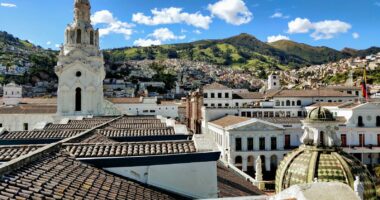
Nestled high in the southern Andes at an elevation of 8,200 feet, Cuenca is one of South America’s most beautifully preserved colonial cities — and one of Ecuador’s greatest cultural treasures. Its historic center is a UNESCO World Heritage Site, characterized by flower-lined cobblestone streets, pastel-colored facades, wrought-iron balconies, and centuries-old churches that reflect the city’s deep Spanish colonial roots.
The centerpiece of it all is Parque Calderón, the main plaza, flanked by two remarkable cathedrals: the iconic Catedral Nueva, topped with its distinctive blue domes that have become the defining image of Cuenca, and the original Catedral Vieja, dating back to the 16th century. Running alongside the city, the Tomebamba River waterfront offers a tranquil walking path lined with indigenous washerwomen’s houses — a living link to the city’s Incan past. Cuenca is also a thriving hub for arts, handicrafts, and gastronomy, making it a genuinely rewarding destination beyond its postcard-perfect looks.
Discover Cuenca’s Food, Culture & Architecture
4. Isla de la Plata
Affectionately nicknamed the “Poor Man’s Galápagos,” Isla de la Plata — or Silver Island — offers a remarkably accessible taste of Ecuador’s extraordinary wildlife without the expense or distance of a Galápagos expedition. Just 25 miles (40 km) off the coast from the fishing town of Puerto López, the island is a quick boat ride into the Pacific and well worth the journey.
The island may owe its name to Sir Francis Drake, who reportedly divided treasure here after capturing a Spanish galleon in 1579. Today, its riches are decidedly more feathered: Isla de la Plata is home to large colonies of blue-footed boobies and masked boobies, whose circular nesting territories of dried excrement dot the island’s hiking trails (watch your step). The undisputed king of the island, however, is the albatross — one of the largest seabirds on earth and an awe-inspiring sight in flight. Snorkeling around the island reveals sea turtles, manta rays, and tropical fish in abundance.
5. Cotopaxi and the Avenue of the Volcanoes
Running roughly 200 miles through the heart of the Ecuadorian Andes, the Avenue of the Volcanoes is one of the most dramatic natural corridors on earth. First named by German explorer Alexander von Humboldt in the 19th century, this spine of towering peaks stretches from Quito south to Riobamba, passing volcanoes including Cotopaxi, Chimborazo, and the twin peaks of the Illinizas.
Towering above them all — at least in terms of fame and symmetry — is Cotopaxi, one of the world’s highest active volcanoes at 19,347 feet (5,897 meters). Its near-perfect cone, capped with glacial snow, is considered one of the most beautiful volcanic forms anywhere on the planet. Cotopaxi National Park surrounds the volcano with high-altitude grasslands, Andean condors, wild horses, and a network of hiking and cycling trails for all ability levels. The park is easily accessible as a day trip from Quito and consistently ranks among Ecuador’s top natural attractions.
Book Cotopaxi & Volcano Tours from Quito
6. The Amazon Rainforest & Yasuní National Park
Eastern Ecuador is dominated by one of the most biodiverse stretches of Amazon rainforest on earth. Covering more than 42,000 square miles of the country’s territory, this vast and largely untouched wilderness is home to an almost unimaginable density of life. Yasuní National Park, encompassing roughly 3,860 square miles (10,000 sq km) between the Napo and Curaray Rivers, is considered one of the most species-rich places on the planet — a UNESCO Biosphere Reserve that scientists regard as one of earth’s last truly wild frontiers.
In Yasuní, you can hike jungle trails beneath a 100-foot canopy, paddle a dugout canoe alongside caimans and river dolphins, and scan the treetops for tapirs, giant anteaters, howler monkeys, and hundreds of bird species. Guided multi-day lodge experiences let you penetrate deeper into the forest and encounter indigenous communities who have called this rainforest home for thousands of years.
Explore Ecuador’s Amazon Rainforest
7. Chimborazo Volcano
Here’s a fact that tends to stop people in their tracks: the summit of Chimborazo, at 20,548 feet (6,263 meters) above sea level, is the single point on earth’s surface farthest from the planet’s core. Because of the equatorial bulge — the Earth is slightly flatter at the poles and wider at the equator — Chimborazo’s peak actually extends further into space than the summit of Everest. In a very real sense, standing on top of Chimborazo puts you closer to the stars than any other place on earth.
The volcano’s massive, glacier-draped flanks are a hauntingly beautiful sight from any angle. Experienced mountaineers can summit Chimborazo in a few intense days with the help of a local guide — it’s a serious climb requiring technical equipment and acclimatization. For those not attempting the summit, the lower slopes offer excellent hiking through dramatic grey moonscapes and past the edge of the glacier, all within Chimborazo Wildlife Reserve, where herds of vicuñas roam freely.
Book Chimborazo Volcano Tours & Adventures
8. Machalilla National Park
Stretching along Ecuador’s central Pacific coast, Machalilla National Park is one of the most ecologically diverse protected areas in the country. This expansive park encompasses a rare coastal fog forest, pristine beaches, four offshore islands (including Isla de la Plata), and a marine reserve that shelters an extraordinary range of wildlife. Armadillos, two species of monkeys, and more than 270 bird species inhabit the park’s varied ecosystems.
The park’s crown jewel is Los Frailes Beach — widely considered one of the most beautiful beaches in Ecuador. Its crescent of soft white sand, clear turquoise water, and dramatic rolling hills is completely unspoiled, and access is limited to protect its natural state. The hike to Los Frailes winds through a coastal dry forest of fragrant Palo Santo trees, their silvery trunks adding an almost mystical quality to the approach. Between June and September, humpback whales migrate through the park’s marine waters, making whale-watching boat tours a spectacular seasonal highlight.
9. Montañita
With a permanent population of fewer than 5,000, Montañita punches well above its weight as one of Ecuador’s most vibrant and internationally beloved destinations. This small surf town on the Santa Elena Peninsula has a magnetic pull that draws backpackers, surfers, digital nomads, and free spirits from around the world — many of whom arrive intending to stay a week and end up staying a year.
The sandy streets are lined with colorful bars, handicraft stalls, and restaurants representing an eclectic global menu: wood-fired pizza, hand-rolled sushi, authentic Mexican street food, fresh ceviche, and everything in between. The waves here are consistent and powerful, making Montañita a serious surfing destination as well as a social hub with legendary nightlife. The beach itself is long, golden, and framed by swaying palms — ideal for sunrise yoga, afternoon surfing, and sunset cocktails in equal measure.
Book Beach & Surf Experiences on Ecuador’s Pacific Coast
10. Otavalo
Two hours north of Quito, the small colonial town of Otavalo sits in a valley ringed by volcanic peaks and holds one extraordinary claim to fame: its Saturday market in the Plaza de Ponchos is the largest open-air indigenous market in all of South America. On market days — and to a lesser extent every other day of the week — the plaza transforms into a vivid tapestry of color, sound, and craftsmanship.
Stalls overflow with hand-woven ponchos, embroidered textiles, hammocks, carved wooden masks, hand-painted ceramics, and jewelry made by members of the local Otavaleño indigenous community. The Otavaleño people are renowned throughout the Americas for the quality of their weaving tradition, which stretches back centuries. Beyond the market, Otavalo’s cobbled streets, surrounding crater lakes, and proximity to the Peguche waterfall make it a compelling destination in its own right — not just a market stop.
Explore Otavalo Market & the Northern Highlands
FAQs: The Most Beautiful Places in Ecuador
What makes the Galápagos Islands a unique destination?
The Galápagos Islands are unlike anywhere else on earth. Their extreme geographic isolation — roughly 600 miles from the South American mainland — allowed species to evolve in near-complete separation from the rest of the world, producing animals found nowhere else, including giant tortoises, marine iguanas, and the various finch species that inspired Darwin’s theory of evolution. Wildlife here is extraordinarily tame, allowing visitors to observe animals at incredibly close range. The surrounding marine reserve is also one of the richest in the world for diving and snorkeling.
What activities can visitors enjoy along the Waterfall Route in Baños?
The Ruta de las Cascadas in Baños caters to adventurers of every persuasion. You can hike or mountain bike the downhill route between waterfalls, zip-line across the river canyon, go white-water rafting on the Pastaza River, try canyoning or bridge jumping, and soak in volcanic hot springs. For a more relaxed pace, simply take the chiva bus along the route and stop at each waterfall for photos and short walks to viewing platforms.
Why is Cuenca considered a cultural hub in Ecuador?
Cuenca’s reputation as a cultural capital rests on several pillars. Its UNESCO-listed historic center is one of the best-preserved examples of Spanish colonial urban planning in the Americas. The city has a thriving arts scene, a strong tradition of handicraft production (particularly Panama hats, ceramics, and jewelry), excellent museums, and a lively calendar of festivals. It also has a notably high concentration of universities, which gives it a youthful, creative energy that sets it apart from other Ecuadorian cities.
What can travelers expect to see on Isla de la Plata?
Isla de la Plata offers a genuinely impressive wildlife experience for a day trip. Blue-footed boobies, masked boobies, and frigatebirds nest across the island’s hiking trails. Albatrosses — among the largest birds on earth — are the island’s most iconic residents. In the waters surrounding the island, snorkelers regularly encounter sea turtles, sharks, manta rays, and colorful reef fish. Between June and September, humpback whales are frequently spotted offshore.
What is special about Cotopaxi National Park?
Cotopaxi National Park is home to one of the world’s highest active volcanoes, standing at 19,347 feet with a near-perfectly symmetrical snow-capped cone. The park’s diverse ecosystems range from high-altitude grasslands (páramo) to dense Andean forest, supporting wildlife including Andean condors, wild horses, deer, and foxes. Hiking, mountain biking, horseback riding, and mountaineering are all popular activities, and the park is easily reached as a full-day excursion from Quito.